Euro NCAP 2026 Raises the Bar for Nighttime VRU: Where Thermal Cameras Add an Edge
As vehicle automation advances towards higher standards in 2026, the reliability of perception systems under real-world conditions has become a critical factor in driving safety, aligning with Euro NCAP 2026’s core shift from passive collision protection to proactive risk avoidance. While visible-light camera perform well in well-lit environments, night driving continues to account for a disproportionate share of severe and fatal accidents, a gap Euro NCAP 2026 now addresses with mandatory nighttime testing and stricter VRU protection criteria.
This structural safety shortfall lays bare the inherent limitations of vision-reliant sensing technologies, and explains why automotive thermal cameras are increasingly recognized as an indispensable layer in advanced driver assistance systems.
How does Automotive Thermal Cameras Work?
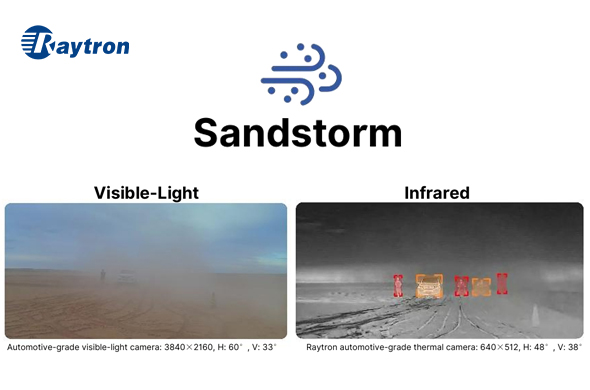
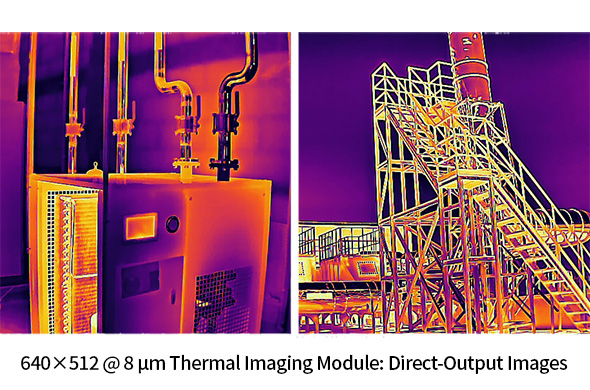
Automotive thermal cameras operate in the long-wave infrared (LWIR) spectrum, detecting heat emitted by objects rather than reflected light. All objects with a temperature above absolute zero emit infrared radiation. Thermal sensors capture this radiation and convert it into electrical signals to generate high-contrast thermal images. Because thermal cameras are passive sensors, they do not require any external illumination and are immune to headlight glare, backlighting, or low sun angles.
This physical advantage positions automotive thermal cameras as a critical redundancy layer within sensor fusion architectures—properly helps OEMs to further comply to Euro NCAP 2026’s “Safety Backup” requirements (Protocol 4.1). The regulation mandates that ADAS systems maintain basic perception capabilities if a single sensor (e.g., RGB camera) fails or is blocked, a need Raytron’s thermal imaging fulfills by providing uninterrupted detection even when LiDAR or vision systems are compromised.
Euro NCAP 2026 Raises the Bar for Nighttime VRU: Where Thermal Cameras Add an Edge
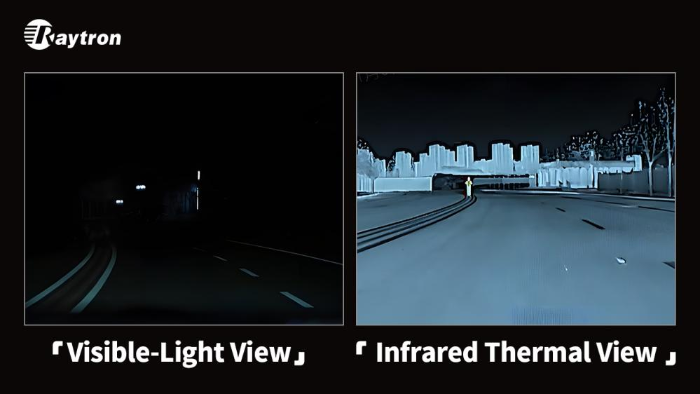
Night driving safety is the primary domain where infrared thermal sensors demonstrate superior performance. Standard headlights typically illuminate a distance of roughly 100 to 150 meters, yet NCAP 2026 requires AEB systems to detect pedestrians and bicyclists at speeds up to 80km/h in unlit environments, far exceeding headlights’ effective range. However, at highway speeds, this stopping distance is often insufficient if an obstacle is detected only within the illuminated range.
Raytron’s infrared cameras for night driving can detect thermal signatures at distances of 300 meters, well beyond the reach of headlights and meeting Euro NCAP 2026’s requirement for extended detection range in nighttime tests. This capability significantly enhances reaction time for both drivers and AEB systems. For a vehicle traveling at 100 km/h, the extra 150+ meters of detection—aligned with Raytron’s automotive thermal imaging specifications—translates to an additional 5.4 seconds of response time, derived from standard speed-distance-time calculations in vehicle safety engineering. This extended response window can help reduce collision risk and supports meeting the "full avoidance" (Vimpact=0 km/h) criteria for nighttime VRU scenarios under Euro NCAP 2026’s Crash Avoidance Frontal Collisions Protocol.
Automotive Thermal Camera Enhances VRU Detection
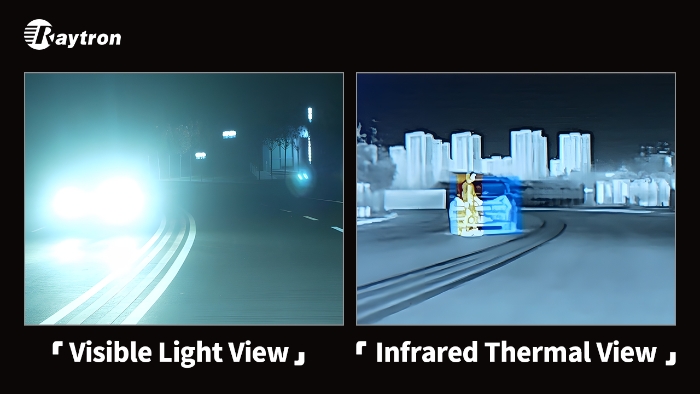
One of the most challenging aspects of automotive night vision is the identification of VRUs. Dark clothing against a dark background creates a low-contrast scenario that challenges computer vision algorithms based on visible light. Automotive thermal cameras for pedestrian detection solve this contrast problem by isolating the heat signature of a human against the cooler background of the environment. Whether a pedestrian is heavily obscured by shadows or standing near blinding streetlights, their thermal emission remains constant. In thermal cameras, living beings appear distinct and bright against the surroundings. This high-contrast data is essential for AEB systems, ensuring that the vehicle can distinguish between a false positive (such as a cardboard box) and a living subject that requires immediate evasion.
About Raytron
As a global leading innovator in infrared thermal imaging, Raytron continues to develop cutting-edge automotive camera systems that drive advancements in autonomous driving and ADAS. With a strong track record of collaboration with top-tier automotive manufacturers and a vision for expanding infrared imaging as a standard in future vehicles, Raytron is helping pave the way for safer and smarter driving.