Mining operations never stop, with overburden removal, loading, hauling and dumping taking place around the clock. Over 40% of mine operating hours fall during nighttime shifts. Blasting often leaves visibility reduced to less than 5 meters amid dense dust clouds. Rough terrain, extreme temperature swings, rockfalls and landslides further complicate mining operations. These are part of daily mining operations and the environment drivers work in every day. Traditional perception systems based on visible-light cameras and LiDAR show clear performance limitations in typical mining scenarios.
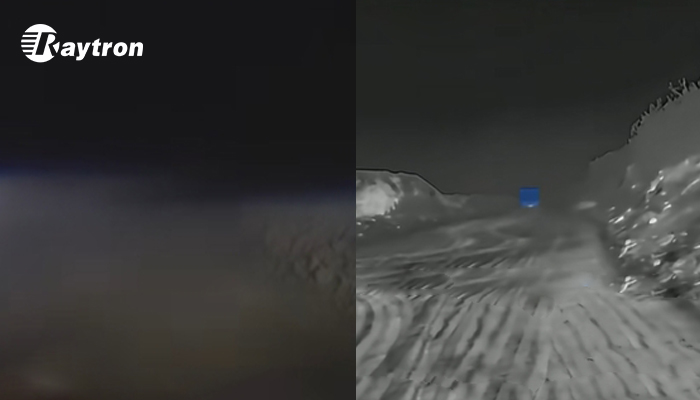
Visible-light cameras rely on ambient light or artificial illumination, which cause glare and cast shadows, creating blind spots and contributing to a higher risk of accidents during nighttime mining operations. Meanwhile, blasting and loading operations in open-pit mines generate large amounts of airborne dust. Dust particles scatter and attenuate LiDAR laser pulses, significantly reducing point cloud density and detection range. In open-pit mines, direct sunlight, work lights and glare from oncoming vehicles can wash out camera images and obscure critical details. Under extreme weather conditions such as rain, snow and fog, reduced visibility significantly degrades the performance of conventional vision systems.
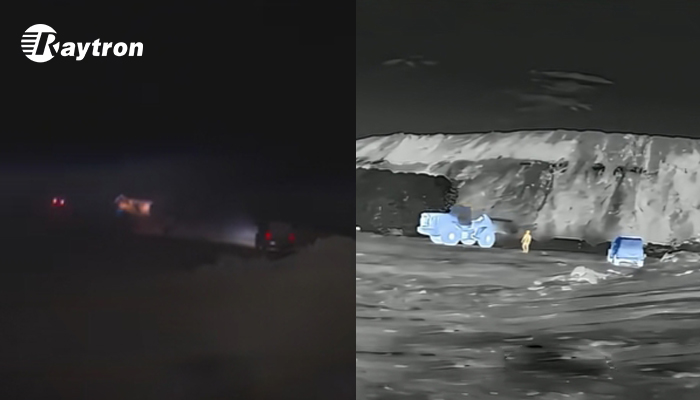
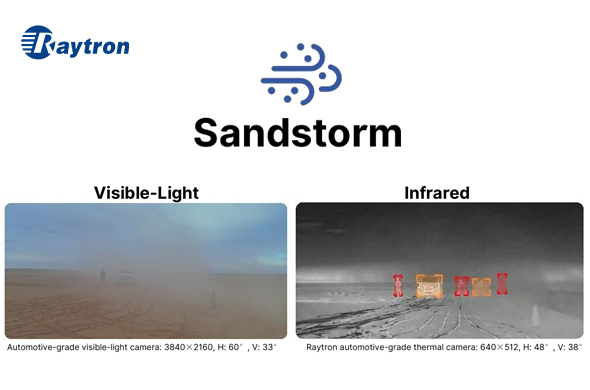
Thermal imaging detects heat emitted by objects rather than reflected ambient light, producing clear images even in complete darkness. In addition, 8–14 μm infrared wavelength range is significantly longer than visible and near-infrared wavelengths, enabling better performance in dusty conditions and clear thermal imaging despite airborne particles.
Built on this physical principle, Raytron’s automotive thermal cameras deliver reliable vision in mining environments characterized by dust, intense light, fog and haze. They require no auxiliary lighting, maintain reliable imaging in dusty conditions, and operate across a wide temperature range of -40°C to 80°C, making them well suited to harsh mining environments.
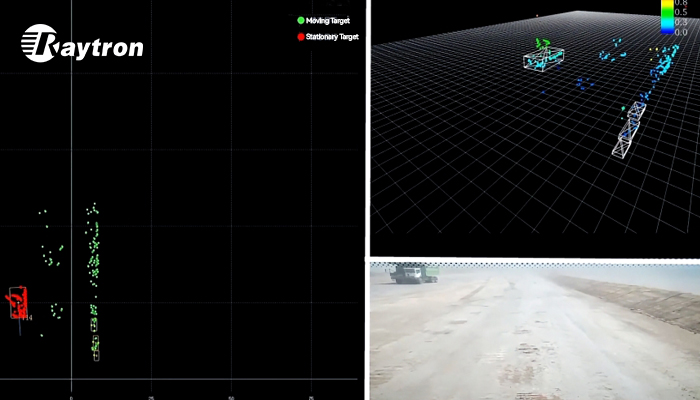
Raytron RA223F 4D imaging radar delivers real-time 4D data across range, velocity, azimuth, and elevation to build high-resolution point clouds. It not only detects obstacles ahead, but also pinpoints their exact location, motion state, and spatial profile—instantly telling whether a target is static or moving, ground-level or overhead, and closing in or receding. Crucially, the millimeter-wave signaling ensures uncompromised detection through heavy rain, fog, dust, and darkness.
For decades, Raytron's smart mining product portfolio covers sensing, communications, and security, combining automotive thermal and 4D imaging radar perception, satellite communication assurance, and thermal fire monitoring to provide an end-to-end infrastructure for modern mining operation.