The development of Advanced Driver Assistance Systems (ADAS) is driving greater demands for vehicle perception. In challenging conditions such as nighttime and haze, single-sensor systems may not provide enough information for reliable perception. To address this challenge, Raytron combines automotive thermal imaging with 4D Imaging mmWave Radar. The two technologies complement each other, providing additional information for vehicle perception.
The Limits of Single-Sensor Perception in ADAS
ADAS typically relies on multiple perception sensors, including visible-light cameras, LiDAR and radar. However, each sensor has its own limitations depending on its sensing principle and operating conditions. For example, visible-light cameras can be affected by darkness, glare and tunnel transitions. LiDAR performance may decline in rain, fog and dust, with sparser point clouds and reduced detection capability. Conventional mmWave radar can also have limitations in identifying certain stationary objects.
Perception in challenging environments is closely linked to driving safety. According to the U.S. Federal Highway Administration (FHWA), more than 50% of fatal crashes occur at night, although only about 25% of vehicle travel takes place after dark. In a separate FHWA study of nighttime driving in fog, object detection distances were reduced by 70%–73% compared with clear conditions. These challenges are driving greater interest in combining different sensing technologies to provide additional information for ADAS perception.
Automotive Thermal Cameras: Principles and Key Advantages
An automotive thermal camera detects infrared radiation emitted by objects and converts it into thermal images through an optical system, infrared detector and image processing. Unlike visible-light cameras, which rely on reflected light, automotive thermal imaging captures information from an object's own thermal radiation. This gives vehicles an additional source of perception information, particularly when visible-light conditions are challenging.
Based on this sensing principle, automotive thermal cameras offer three key advantages for ADAS perception:
1. Perception in Challenging Lighting Conditions
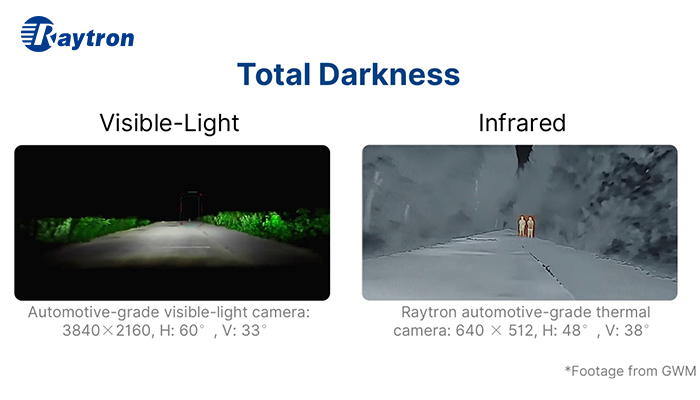
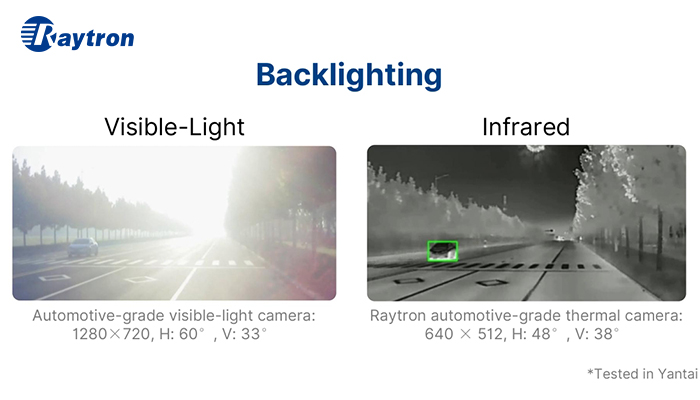
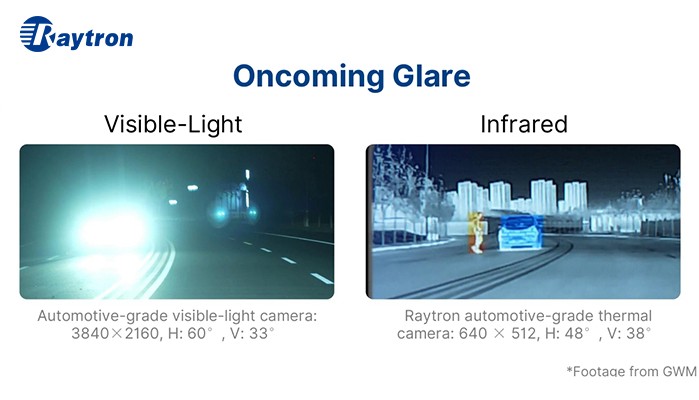
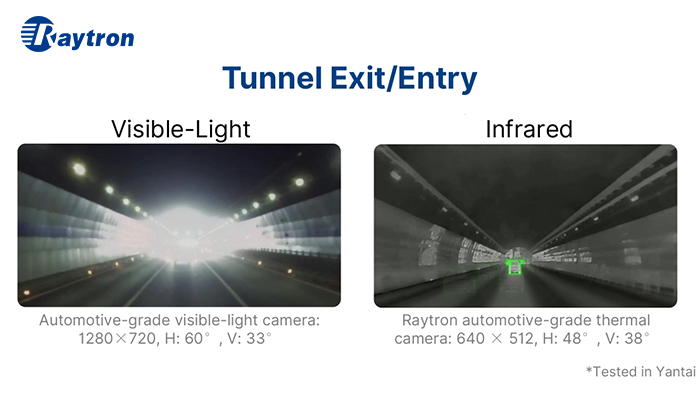
At night, in low light, glare or backlight, visible-light images can lose contrast or important details. An automotive thermal camera detects thermal radiation rather than relying on ambient light, helping vehicles perceive road users such as pedestrians and vehicles in these conditions.
2. Additional Perception in Poor Visibility
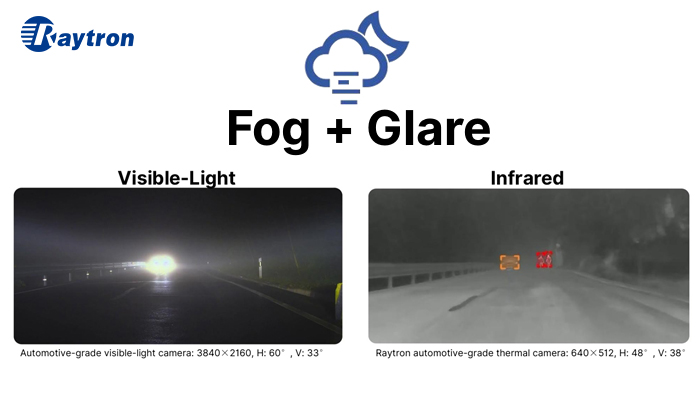
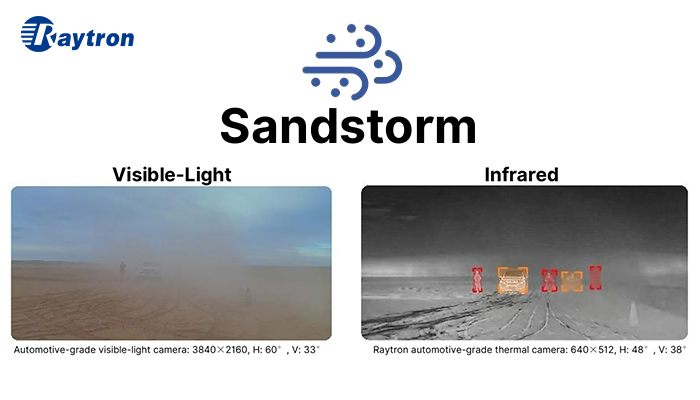
In fog, haze and dust, visible-light images can be affected by scattering and reduced contrast. Long-wave infrared (LWIR) imaging detects differences in thermal radiation between objects and their surroundings, providing information beyond visible-light images and helping vehicles perceive their surroundings in low-visibility conditions.
3. Enhanced Detection of Living Targets
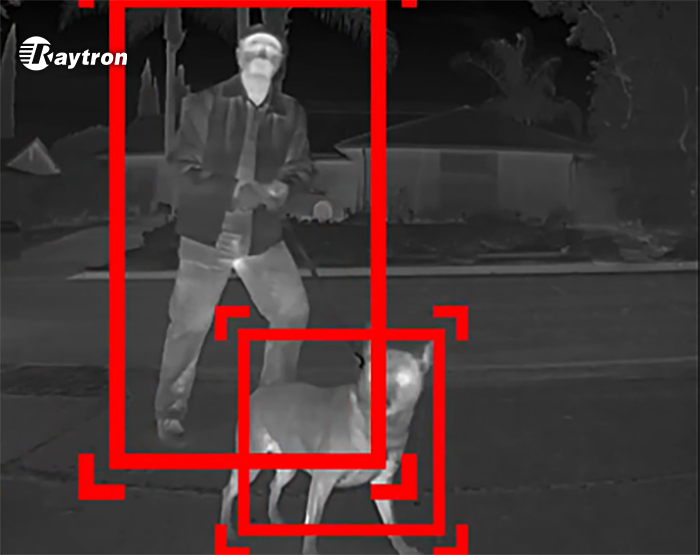
The human body, at a typical temperature of around 37°C, emits infrared radiation with a peak wavelength of approximately 9.3 μm, within the 8–14 μm operating range of LWIR imaging. This allows automotive thermal cameras to capture thermal radiation from living targets, including pedestrians, cyclists and animals. Trained on more than 200,000 real-world road scenes and 150,000 images of cats and dogs, the technology further supports the recognition of diverse living targets.
For complex driving environments, a single sensor may still have perception limitations. Raytron combines automotive thermal imaging with 4D Imaging mmWave Radar: thermal imaging captures the thermal characteristics of targets, while 4D Imaging mmWave Radar provides range, azimuth, elevation and velocity information. Based on different sensing principles, the two technologies provide complementary information and support multi-sensor perception for ADAS.
From Automotive Sensing Technologies to Mass Production
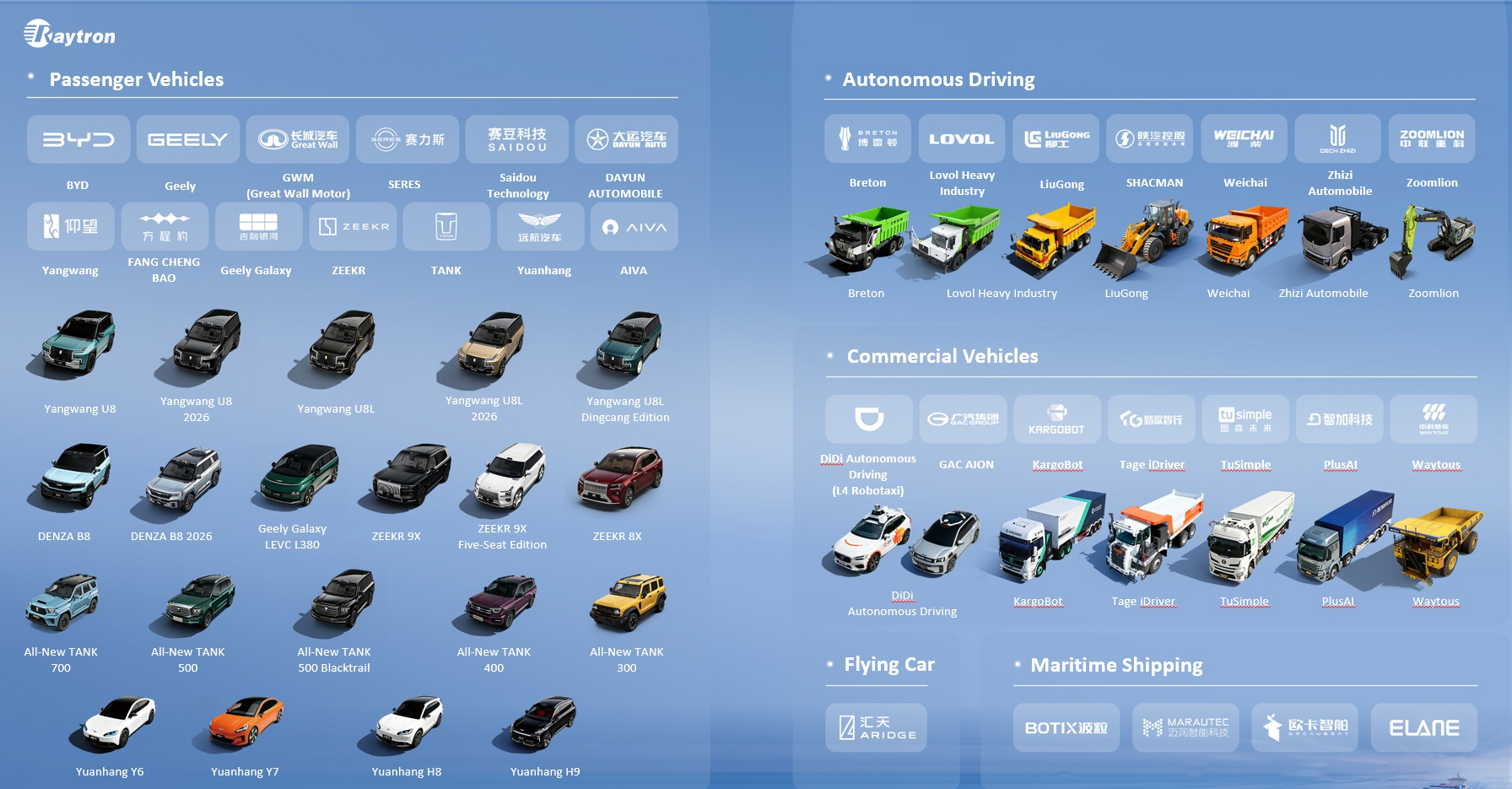
Mass production is an important test of automotive sensing technologies. To date, Raytron’s automotive thermal imaging systems have been deployed across more than 25 automakers, including BYD, Geely, Great Wall Motor, Breiton and Carl Power. Across automotive and other transportation applications, Raytron’s thermal imaging systems have supported more than 30 vehicle and vessel models.
Raytron's automotive sensing portfolio covers both automotive thermal imaging and 4D Imaging mmWave Radar. For automotive thermal imaging, Raytron offers automotive-grade capabilities spanning chips, modules, end products and AI algorithms, with solutions for exterior OEM systems, industry aftermarket applications and consumer aftermarket products. For 4D Imaging mmWave Radar, Raytron offers products that provide range, azimuth, elevation and velocity information, adding spatial and motion data to ADAS perception.
By combining automotive thermal imaging with 4D Imaging mmWave Radar, Raytron offers automotive OEMs and Tier 1 suppliers options ranging from individual sensing products to multi-sensor perception solutions for different ADAS applications.
About Raytron
As a leader in infrared thermal imaging, Raytron has built a full-chain product portfolio for automotive applications, spanning from in-house developed chips to complete imaging systems, and from mass-produced OEM solutions to convenient aftermarket products. By combining automotive thermal imaging with 4D Imaging mmWave Radar, Raytron provides vehicles with more comprehensive environmental perception capabilities, supported by its mass-production experience and product portfolio for the application of multi-sensor perception solutions across different vehicle models.