Visualize Invisible Temperature: Infrared Thermal Imaging in Food and Beverage Processing
The World Health Organization (WHO) estimates that roughly 600 million people fall ill annually from consuming contaminated food. In food and beverage production, temperature ranks among the most critical parameters influencing food safety, processing quality, and product consistency. For cooking, pasteurization, drying, fermentation, and cooling operations, temperature control directly determines final product quality and production stability. Real-time thermal monitoring offers critical visibility into temperature dynamics throughout these processes.
Traditional food processing relies heavily on operators assessing material conditions through touch, sight, and experience. During jasmine tea scenting, for instance, artisans adjust operations based on pile temperature and condition. In baijiu (a traditional Chinese distilled spirit) distillation, operators judge processing status by observing steam patterns and other visual cues. Infrared thermal imaging detects surface infrared radiation and converts it into visual temperature maps. This provides a more intuitive and quantifiable basis for temperature assessment, reducing reliance on subjective experience.
Why Does Thermal Imaging Matter in Food and Beverage Processing?
Temperature as the Core Variable in Food and Beverage Processing
Temperature control spans multiple stages of food and beverage processing, from cooking and pasteurization to drying, fermentation, and cooling. Under HACCP frameworks, specific thermal processing and cooling steps are designated as Critical Control Points (CCPs) because temperature directly affects microbial control and product quality. In continuous production, temperature variations often occur across equipment and materials. A single target temperature does not guarantee process-wide stability. Detecting these variations in real time is essential for maintaining processing consistency.
Three Limitations of Traditional Temperature Measurement Methods
Subjectivity of manual experience. Traditional temperature assessment relies mainly on the tactile and visual judgment of experienced workers. In jasmine tea scenting, fresh flowers must stay within 32–37°C to fully open and release fragrance. If the temperature drops below 30°C, the pile must be stacked to retain heat; above 38°C, it must be spread to cool. Such decisions rely heavily on operator experience and are difficult to assess consistently through touch alone.
Interference from contact-based measurement. Probe thermometers and thermocouples require direct material contact. This can disrupt the process environment—for example, disturbing the loose structure of a scenting pile—and prevents simultaneous monitoring across large areas.
Blind spots in single-point measurement. Traditional methods capture only discrete temperature points, missing the full surface distribution. During baijiu steaming, uneven surface temperatures in the distillation pot can lead to misidentification of steam escape points, potentially compromising process consistency and liquor quality.
Technical Advantages of Infrared Thermal Imaging
Infrared cameras detect surface infrared radiation and convert it into visual thermal maps. This enables non-contact, full-field, continuous temperature monitoring. In the food industry, thermal imaging technology has been successfully applied to temperature monitoring, bruise detection, foreign object identification, and liquid level assessment.

Infrared thermal camera highlighted in red for temperature monitoring in a Baijiu production facility
Use Cases: From Jasmine Tea Scenting to Baijiu Distillation
Jasmine Tea: Making the Scenting Process Visible
During jasmine tea scenting, mixing tea leaves with fresh flowers generates heat. Pile temperature changes continuously with environmental and processing conditions. According to GB/T 34779-2017 Technical Specifications for Jasmine Tea Processing, timely cooling and ventilation are required when temperatures reach specified ranges. Accurately assessing pile temperature is therefore critical for controlling the scenting process.
Traditional operations rely mainly on touch and experience. Infrared thermal cameras capture surface temperature distribution without material contact, visually displaying regional temperature differences and trends. For modern production, this thermal imaging data augments manual judgment and supports continuous temperature monitoring and process data logging.
Baijiu: Seeing Temperature Changes During Distillation
During the steaming stage of baijiu brewing, distillers judge processing status by observing steam at the fermented grain surface. They adjust material distribution based on steam visibility. As steam rises from within the fermented grain to the surface, it creates temperature differentials that produce identifiable thermal signatures for infrared imaging.
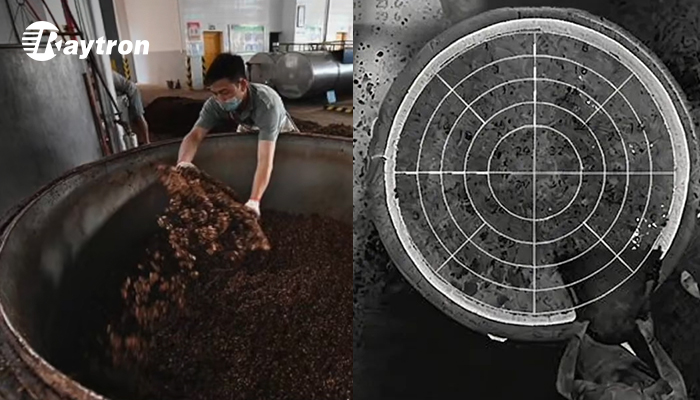
Baijiu fermentation shown in visible and thermal images for temperature monitoring
Infrared thermal cameras capture the surface temperature distribution of fermented grain without contact. They convert steam-related temperature characteristics into visual thermal maps, providing operators with actionable thermal data. This technology is already being integrated into intelligent baijiu brewing lines. Combined with automated steaming equipment, it assists with temperature probing and material distribution, providing sensing data to digitize and automate traditional steaming processes.
3 Advantages of Infrared Thermal Imaging in Food Processing
Real-Time Temperature Visualization
Turning tactile judgment into visual temperature data.
Infrared thermal imaging captures surface temperatures without physical contact, presenting regional temperature distributions as thermal maps. Unlike experience-based or single-point methods, this approach allows operators to intuitively identify high-temperature zones, low-temperature zones, and temperature shifts. This enables timely anomaly detection and informs process adjustments.

For baking, heating, and cooling, this visualization helps identify localized temperature differences. For example, if a continuous heating device has uneven heating, a few measurement points may not reflect the full thermal state. The system locates abnormal regions directly in temperature images.
Non-Contact Continuous Monitoring
Continuous temperature observation without material contact.
For scenting, brewing, baking, drying, and cooling, materials may be in motion, at high temperatures, or otherwise inaccessible. Infrared thermal imaging continuously acquires temperature data from a distance. This reduces the constraints of contact-based measurement and can be deployed on production lines or equipment for continuous process monitoring.
Data Connectivity for Process Optimization
Turning a single temperature observation into recordable, analyzable process data.
These systems display real-time thermal maps and enables data logging, trend analysis, and anomaly detection. In traditional food processes, temperature changes once judged by experienced workers can now be recorded. These systems can be configured with preset temperature zones and thresholds to support anomaly detection, alarm generation, event logging, and trend analysis. In modern smart manufacturing, thermal data can be integrated with production and control systems to support process optimization and automation.
Other Applications of Thermal Imaging in Food Processing
The applications of infrared cameras extend far beyond temperature monitoring of the food itself; they can be applied across multiple stages of the production chain. The following table summarizes typical application scenarios of how this technology works in food and beverage manufacturing:

Infrared Technology Transforms Food Processing from Experience to Precision
From jasmine tea artisans "touching flowers to make tea" to baijiu brewers "probing temperature before loading the steamer," temperature has never been merely a number. It is the foundation of aroma, taste, and quality. Infrared thermal imaging does not replace decades of master craftsmanship. It transforms tactile judgment and visual observation into quantifiable, traceable, and shareable data.
Today, as global food and beverage manufacturers strive to balance artisanal quality with scalable consistency, this technology serves as a critical bridge between the two. When temperature becomes visible and measurable, thermal data supports data-driven process optimization and consistent quality monitoring. Enabling centuries-old craftsmanship to evolve in the digital age is the true value it brings to the food and beverage industry.
About Raytron
Raytron specializes in infrared, microwave, and laser sensing for industrial applications worldwide. Its capabilities include multi-spectral chip design, AI-driven algorithms, and large-scale manufacturing. The company provides thermal imaging sensors, infrared detectors, and integrated sensing solutions for industrial temperature measurement, outdoor night vision, infrastructure safety, and intelligent systems across global markets. These solutions enable food and beverage manufacturers to monitor temperature and maintain process consistency.